Wednesday, June 14, 2006

National Pork Board to purchase "Other White Meat" brand rights for $60 million; USDA keeps financial details secret

In a deal that is scheduled to take effect July 1, the federal government's National Pork Board plans to purchase rights to the "Other White Meat" brand from the National Pork Producers Council, a private trade association, for $60 million.

The deal will not help pork producers improve demand for their product, because the Pork Board already uses the "Other White Meat" slogan in well-known national advertising campaigns.

Instead, the sale will circumvent federal restrictions on how the National Pork Board may use money that it collects in taxes or mandatory assessments on pork producers and importers. The sale will funnel $3 million each year for 20 years to the National Pork Producers Council, a private industry association whose heavy influence over the federal government's Pork Board has long been controversial. The Council, in turn, can spend the $60 million without federal government oversight.

The general description of the sale was provided in a press release from the National Pork Board in March, and the latest news was reported by Brownfield Ag News on Friday.

The National Pork Board was established by Congress in 1985, and the Board members are appointed by the Secretary of Agriculture. As with other "checkoff" promotion programs, the federal government enforces the collection of the mandatory assessments, amounting in the case of pork to more than $60 million per year. Some pork farmers oppose these industry schemes (see here and here), but even a successful referendum to end the program was overturned through the influence of the Council.

Government and industry officials sometimes describe the Board as a producer self-help organization, but its role as a government program was finally settled by the Supreme Court in a May, 2005, ruling on the related beef "checkoff" program. In this case, the federal government argued -- and the Supreme Court agreed -- that such government sponsored advertising campaigns for dairy, beef, and pork are "government speech" and farmers must pay the mandatory assessments as they would any government tax.

The National Pork Producers Council is a private trade association that gets paid as a subcontractor to the National Pork Board. A USDA Inspector General report (.pdf) in 1999 explained:
Our evaluation did not disclose material misuse or loss of checkoff funds, but it did find the Board has relinquished too much authority to its primary contractor, the National Pork Producers Council (NPPC), and has placed the NPPC in a position to exert undue influence over Board budgets and grant proposals. The Board has awarded all program grants to the NPPC since 1996. The Board itself has not hired sufficient staff to administer and provide adequate oversight of the checkoff program. The Board employs only two persons (an Executive Vice President and an assistant), to oversee $60 million in annual checkoff collections, distribution, and use. The Board's degree of dependence on the NPPC to administer subcontracts and carry out much of the Board's work resulted in a weakened accountability over contributed funds.
In response to the Inspector General's report and related litigation, USDA began to insist (.pdf) that the Board's operations be strengthened and that contracting relationships between the Pork Board and the National Pork Producers Council have an "arm's length character." For example, the Pork Board staff moved out of the National Pork Producers Council's office to a nearby location leased from the Council.

It is not clear whether the new proposed sale of the "Other White Meat" brand has an "arm's length" character. The press release from the National Pork Board claims that the $60 million sale price is based on unspecified "appraisals." The press release argues that this price reflects the cost of replacing the "Other White Meat" brand, should the Pork Board choose to develop a new brand instead.

That reasoning is questionable, however, because much of the intangible equity in the "Other White Meat" brand comes from the investment of millions of dollars per year in advertising funded by the Pork Board, not by the National Pork Producers Council. The Council has nobody else to whom it could sell the brand, so it is hard to imagine there are any competitors bidding up the price of the brand. Until the documents are made public, one has to suspect these "appraisals" are just window dressing for an insider deal to benefit the National Pork Producers Council.

Clearly, it is important for the public to see these appraisals before the deal is completed. Otherwise, the miscarriage of the public interest will be apparent only after it is too late to reverse the decision.

Unfortunately, in response to repeated inquiries of both program and public information staff at the Agricultural Marketing Service at USDA, nobody would answer my questions or provide the appraisals. Consequently, I filed a Freedom of Information Act request in April, requesting these documents.

The response I received today is clever. It says USDA has found 12 pages of documents that are responsive to my request for information, but 10 of those pages are being withheld from the public for now because they are "pre-decisional" or "deliberative." These will be shared with the public as soon as USDA finalizes the deal -- when the information will be too late to do any good.

What were the 2 pages that USDA did share with me? A photocopy of the National Pork Board's press release from March!

In the never-ending struggle between those who would share information needed for sound public policy, and those who would hide it, I feel that I have been beaten by a real talent.

Perhaps a sharper reporter will pick up this story before the USDA approval is finalized.

Sunday, June 11, 2006

Marion Nestle: What to Eat?

Marion Nestle asks some good questions about supermarkets in the introduction to her new book, What to Eat.
Why, I wondered, do they sell this and not that? Why are entire aisles devoted to soft drinks and snack foods? What do the pricing signs mean, and how do they work? Why is it so hard to find some things, but not others? Are there any genetically modified or irradiated foods among the fruits and vegetables? What does "Certified Organic" mean, can it be trusted, and is it worth the higher price? Is soy milk healthier than cow's milk? If an egg is "United Egg Producers Certified," is it better? Is it safe to eat farmed fish or, for that matter, any fish at all? Is it safe to eat take-out foods? If a sugary cereal sports a label saying it is whole grain, is it better for you? Does it make any real nutritional difference whether you buy white or whole wheat bread?
And she offers this interesting reflection on difficulty that she, Marion Nestle, Ph.D., chair of a leading nutrition department, author of several lucid and influential books on related topics, faces in answering such questions.
If you have trouble dealing with supermarkets, it is for a good reason. You need to know an amazing amount about our food system and about nutrition to make intelligent choices, but most of this information is anything but obvious. It is not supposed to be obvious. Supermarkets have one purpose and one purpose only: to sell food and make a profit, and as large a profit as possible. Your goals are more complicated: you want foods that are good for your health, but you also want them to taste good, to be affordable, to be convenient to eat, and to reflect social values that you might care about. In theory, your goals could overlap with the normal business interests of supermarkets. After all, they do sell plenty of inexpensive, convenient, tasty foods that are good for you. But in practice, you and the supermarket are likely to be at cross-purposes. The foods that sell best and bring in the most profits are not necessarily the ones that are best for your health, and the conflict between health and business goals is at the root of public confusion about food choices.
Here is an NPR interview with the author.

Schlosser, Linklater, Hawke and Fast Food Nation

From Fox Searchlight Pictures, on YouTube, here is the amusing trailer for Fast Food Nation. My wife and I both liked Schlosser's book. Plus, we like director Linklater and -- this is the embarrassing part -- we enjoyed Ethan Hawke's work for him in Before Sunrise and Before Sunset. The rest of the cast includes Kris Kristofferson, Avril Lavigne, Patricia Arquette, and more. Fall 2006.


But why did they bleep out the tag line, "There's something in the meat"?

Saturday, June 03, 2006

American Farmland Trust: "green payments" in place of traditional commodity support

The 2007 Farm Bill proposal from the American Farmland Trust has three pillars: (1) a safety net, emphasizing non-trade-distorting "green payments" and risk-management tools, (2) stewardship policies, including conservation programs, and (3) new markets, by which the Trust appears to mean even-handed reciprocal trade access and increasing the profile of fruit and vegetable crops that have not traditionally been program crops.

The Trust's press conference last month included bipartisan support from former agricultural secretaries Clayton Yeutter and Dan Glickman. From the Delta Farm Press coverage:
“The clock is ticking for U.S. agriculture,” said Yeutter. “Our farmers and ranchers can and should control their own destiny by taking the lead on farm policy reform. The alternative is to risk World Trade Organization (WTO) challenges that may impose reforms on us that we would prefer to avoid — like the reforms that have already occurred in cotton. Either way the stage is set for major policy changes. If we handle them skillfully and creatively we can eliminate our WTO vulnerability while still serving U.S. farmers well.”

AFT’s proposal is the “right formula for converting a potential policy train wreck into an unprecedented opportunity for a new generation of farmers and ranchers,” added Glickman. “These recommendations will recognize and reward farmers for stewardship of our nation’s resources and improve the nutrition of our citizens through expanding access to specialty crops and fresh, locally grown food. This vision will rebuild public confidence in federal agriculture spending.”
Interesting.

USDA: Americans consume too many calories from SoFAAS (sofas?!)

A long-standing unwritten rule or tradition at USDA limits what nutrition educators can say. One may speak freely about foods that are encouraged, such as fruits and vegetables and whole grains. One may speak in general terms about limiting vague nutrients, such as saturated fat. However, one may not speak too plainly about reducing or limiting particular food groups, such as meat or high-fat dairy. USDA promotes those foods.

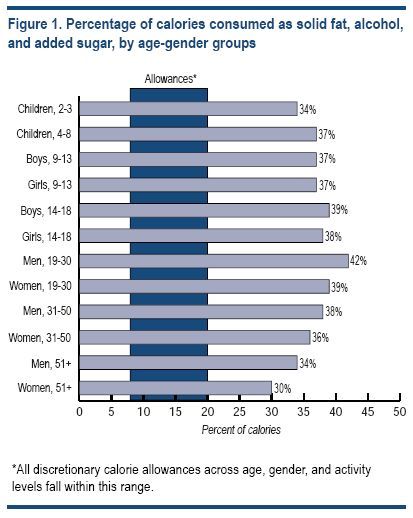
An interesting report (.pdf) this month from USDA's Center for Nutrition Policy and Promotion approaches the limits of permitted boldness. The title emphasizes what to eat less: "Americans consume too many calories from solid fat, alcohol, and added sugar."

The revised Dietary Guidelines for Americans and the new MyPyramid graphic received some critical comment for introducing the concept of "discretionary calories." The idea is that, if you are an active person with high energy (calorie) needs, and you have already chosen enough healthy foods to meet your other nutrient needs, you might feel free to fill out the remainder of your energy needs with some treats. Most nutrition educators actually agree with the science behind this concept, I think, but many worried it would imply endorsement for all sorts of unhealthy foods. The real question was whether USDA's nutrition communicators would make clear the limits on the recommended amounts of these discretionary calories.

This month's report seems fairly clear. While recommended discretionary calories for certain age and gender groups might reach as high as 20 percent of all food energy, the accompanying graphic shows that American intake of unnecessary sugar, alcohol, and solid fats is vastly higher.

In keeping with the tradition of mentioning nutrients in an opaque way without criticizing particular foods, the report uses the bulky acronym SoFAAS to indicate solid fats, alcohol, and added sugars.

Beyond that acronym, would the report courageously mention particular foods to eat less? Well,... er,.... "Future research will focus on ... examining the sources of these calories, and applying the concept of SoFAAS to identify the nutrient density of various foods."


Source: USDA/CNPP.

Wednesday, May 31, 2006

Women in food insecure households are more likely to gain weight

Food insecurity appears to be related to weight gain in women. Researchers had already noticed that women in food insecure households were more likely to be overweight. The new contribution in a study by Jerusha Peterman and myself, recently in the Journal of Nutrition, is to use nationally representative data to measure the change in weight over the same 12 month period for which food security status is measured.

We found that women in fully food secure households had a comparatively low probability of gaining 10 lbs or more during the year, and women with intermediate levels of food insecurity (such as "food insecurity without hunger") had the highest frequency of gaining 10 lbs or more. Women with the most serious evidence of food insecurity with hunger were back to having a comparatively low risk of gaining 10 lbs or more.

What could be going on? Perhaps an involuntary "boom and bust" food cycle due to food insecurity tricks the body's metabolism into retaining calories when they are available. Or perhaps the same resource cycle simply provokes people to eat bad inexpensive food when resources are scarce. Or perhaps both food insecurity and weight gain were caused by some other factor, which we were not sufficiently clever to measure. Because it looks at weight change, rather than just cross-sectional comparisons across people, the study increases the circumstantial evidence that food insecurity leads to weight gain, but it still falls short of proving causation.

We don't know why the same pattern didn't show up for men.

I got interested in this topic after studying the "food stamp cycle" in my dissertation and later research some years ago. It turns out that a large fraction of people's benefits are spent in the first few days after they are received. I think it would be worthwhile to study policy options such as delivering benefits twice monthly, to see if this approach improves the program's effectiveness in promoting both food security and good nutrition, without deterring participation by imposing undue hardship on program participants.

This research also may call into question whether "losing weight" should be one of the 18 items on the federal government's official food security survey. It happens that USDA's Economic Research Service is currently seeking public comment about the content of that survey, with a deadline of June 16 for comment submission (.pdf). I will share my thoughts in a future post, in addition to sending the comments to ERS, but if you are thinking of sending comments, see first the recent National Academies report on the topic for a bunch of context.

The Journal of Nutrition paper has received a good deal of press in the past few days. My school's public relations office described the article in a "policy point." The research was summarized in a brief by Sena Desai Gopal in the Boston Globe (scroll past the first article here) and an article by Amy Norton on Reuters.

Jerusha is giving a brief presentation of the paper at the annual meeting of the American Agricultural Economics Association (AAEA), as part of a "track" of sessions sponsored by the Food Safety and Nutrition Section, on Monday July 24 in Long Beach, CA. The session (.pdf), which includes other papers on food security measurement, including a briefing about the National Academies Report, is titled, "Hunger in America: A moment of reflection on U.S. food security measurement."

Thursday, May 25, 2006

Meg Hourihan's food weblog, megnut

Megnut, the long-time weblog by Meg Hourihan, Tufts alum and one of the founders of Pyra Labs (predecessor to Blogger), is now a lively food blog.

An amusing feature article recounts her thwarted efforts to compare fresh and frozen fish in a scientifically designed taste test.