Tuesday, January 22, 2013

Link between television and weight

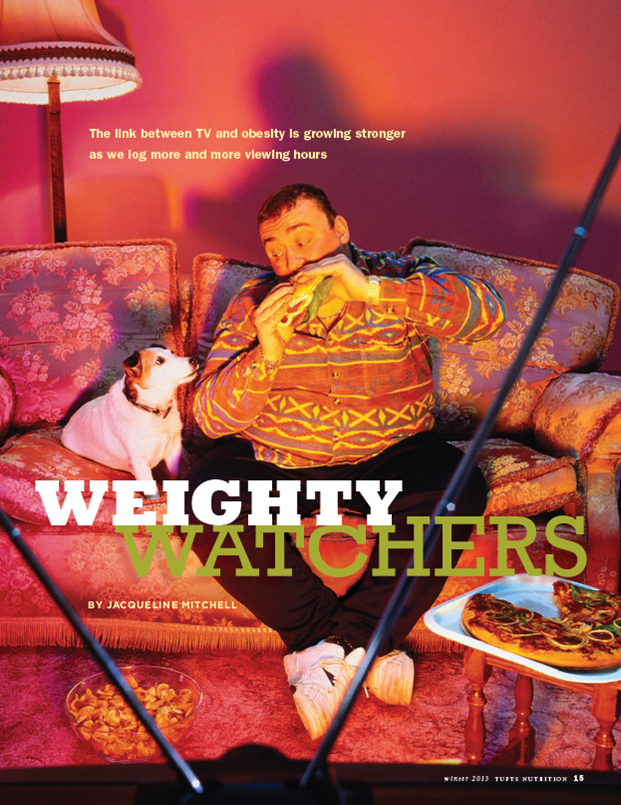
In the current issue (.pdf) of the magazine Tufts Nutrition, Jacqueline Mitchell describes recent research on television viewing and weight status.
Americans spend an average of more than 150 hours a month in front of the television — that’s six days—and never mind other sedentary hours we spend with computers or mobile devices. As our screen time has exploded, so has the national waistline. Two-thirds of adults are overweight, and childhood obesity has more than doubled in the last 20 years.

One reason obesity may be on the rise is that people who watch a lot of television may eat more, particularly pizza, soda and other fast foods, according to a recent Tufts study that evaluated 30 years of research linking TV viewing with weight gain. The paper, written by four students and their adviser, Robin Kanarek, Ph.D., interim dean of the Friedman School, was published online in the June 4 edition of Physiology and Behavior....  The research by Kanarek and the students—Rebecca Boulos, N13; Emily Vikre, N08, N13; Sophie Oppenheimer, N11, MPH11; and Hannah Chang, A10—also indicated that television can shape societal views about overweight and obese people.


Friday, January 18, 2013

Colbert covers the VitaminWater lawsuit

In food advertising and labeling law, there is a concept called "puffery." It means advertising or labeling claims so outlandish that reasonable adults will recognize their falsehood.

You might think that health advocacy groups would use the word "puffery" as an insult when describing food company advertising. Not so.

Instead, it is the food companies who use the word "puffery" in legal briefs defending their own advertising. As in: "Sure, our advertising claim was false, but so what? Our claim was mere 'puffery.' We have no legal obligation to stand by its truth." I thought of this arcane field of puffery-related law while watching Colbert's coverage of the Coca-Cola VitaminWater lawsuit this week.

Thursday, January 17, 2013

IOM report considers time constraints as part of assessing SNAP benefit adequacy

The Institute of Medicine, part of the National Academies, today released a consensus report on the adequacy of Supplemental Nutrition Assistance Program (SNAP) benefits.

The committee that prepared the report was led by Julie Caswell of UMASS Amherst.  Members included Mary Muth, Philip Gleason, Jim Ziliak, Barbara Laraia, Diane Schanzenbach, and others.  The committee had invited me to Washington for a workshop in spring 2012 to give a presentation (.pdf) about the economics of the SNAP benefit formula, the procedure that the federal government uses to assign a benefit amount to each participant household based on its income and other characteristics.

In one notable conclusion of today's report, the committee suggested that the federal government should account for the difficulty low-income families face in finding sufficient time to cook at home.  The implication is that the government could consider increasing SNAP benefits to provide low-income households with sufficient resources to purchase more convenient and easy-to-prepare foods:

Time—USDA-FNS should recognize the cost-time trade-offs involved in procuring and preparing a nutritious diet. The dollar value of the Thrifty Food Plan (TFP), with its strong reliance on preparation of meals from basic ingredients, does not account for time constraints faced by most households at all income levels, particularly those with a single working head of household, which necessitate purchasing value-added or prepared foods with a higher cost. USDA-FNS should examine the impact of accounting for cost-time trade-offs, for example, by:
  • applying a time adjustment multiplier to the cost of the TFP or reviewing options for adjustments to the current cost of the plan, and
  • adjusting the earned income deduction to reflect more accurately time pressures for participants who are working. 
One question is whether encouraging greater food spending on convenient foods would have any health or environmental consequences.  For example, convenience foods tend on average to have more sodium and more packaging than their traditional counterparts.

Clearly, an increased benefit to allow for convenience foods would be a special boon for highly time-constrained households -- think for example of the dreadfully tight time budget for a low-income working single parent.  Yet, many other low-income SNAP participants are retired, or live in households that include a non-working adult.

Some low-income households are able to -- and even want to -- cook at home.  For these households, it might be counter-productive to increase the maximum benefit to a level based on the price of expensive convenience foods, while simultaneously forbidding the households to economize on food and use the savings for non-food needs such as housing and transportation.

While you're thinking this over, I thought it would be helpful to conclude with some real data from the American Time Use Survey for 2011.  Most of the leisure time segment at all education levels is for television and other screen-time recreation. Source: American Time Use Survey. Note: the amount of work time appears smaller than you may expect, because the data include both weekdays and weekends, averaged for working and non-working persons aged 15 and older.

Monday, January 14, 2013

Sound Medicine: How does farm policy affect the nation's nutrition and health?

I recently spoke with Barbara Lewis at the Indiana NPR program Sound Medicine about the Farm Bill and nutrition.  The program website has full audio.  Here is the abstract from the program.
A large piece of legislation known as the Farm Bill has been stalled on the House floor because of budgetary concerns. The Farm Bill addresses issues such as rising milk prices, nutrition assistance programs for the poor and agriculture subsidies. Without the passage of this legislation, the farming industry has been reverting to outdated policy. Parke Wilde, Ph.D., discusses policy changes that would have a positive impact on the nation and how components of the Farm Bill would effect change. Dr. Wilde is an associate professor in the Friedman School of Nutrition Science and Policy at Tufts University and the author of the upcoming book, “Food Policy in the United States: An Introduction.”

Friday, January 11, 2013

Wayne Pacelle and Chuck Jolley discuss pork checkoff

Veteran food industry journalist Chuck Jolley recently discussed the pork checkoff program with Wayne Pacelle, president of the Humane Society of the United States (HSUS).  Jolley asked Pacelle if the recent HSUS lawsuit against the pork checkoff program was "legal shenanigans" or a substantial case.  Pacelle's response noted some recent reporting on the U.S. Food Policy blog.
Warner left no doubts about the NPPC position. Let me ask the question posed in my column directly to you: “Does HSUS have a case against the National Pork Board or are they just engaging in some legal shenanigans in order to force NPB to the bargaining table?”

A: You can read our complaints. We have (hard evidence) that the Pork Board used check-off funds to participate in NPPC lobbying events. NPPC says the charges are baseless, yet it quickly acted to remove evidence of the Board’s high-donor “Partner” status in its Alliance lobbying program. Within days of the HSUS complaint, the U.S. Food Policy blog reported that the Pork Board had been (removed) from the Alliance website.

HSUS and pork farmers also filed a (complaint) over the $60 million pay-out from the Pork Board to the NPPC for the use of the ‘Pork: The Other White Meat’ slogan. NPPC used $500 million from the checkoff to make the slogan successful, so producers should not have to pay again for it, especially in light of the slogan being put to bed.

Sunday, January 06, 2013

Bread for working people

A friend taught me how to make this oat/wheat combination bread.  While some bread recipes save time by using just a single rise, this bread has two rises, but there is a twist that makes it quite friendly for people with a day job.

The first kneading is at night.  The following morning, the steps for putting dough in pans, allowing a second rise, and baking, each take just a few seconds and seem timed just right to fit between morning tasks of waking up, showering, dressing, breakfast, and out the door.  By some measures you'd have to say home-made bread takes hours of work, but if we choose a recipe that fits our schedule, we get three loaves of fresh bread for about 45 minutes' work (in the evening, in the kitchen, with music on the radio, sometimes with kids around chatting, at a time of day when I didn't want to do other work anyway).

As I smell this bread before eating it the next evening, I think there are some things that statistics on food prices and time use will never quite measure.

Friday, January 04, 2013

Food-related environmentalism and flying

Many readers of this blog seek to make environmentally sustainable food choices.  Good choices include eating food with less meat, less processing, and less food packaging.  We can choose food sourced in season and closer to home.  We can waste less.

For some of us in first-world countries, the benefit of these choices is more than offset by the impact of frequent flying.

The book by Berners-Lee, How Bad Are Bananas?, which I discussed a couple months ago, gives the technical details on greenhouse gas estimates.  Buses and trains have vastly lower impact, and even automobile driving is much better so long as the vehicle carries multiple passengers.

In the New York Times recently, M. Sanjayan, the lead scientist for the Nature Conservancy, reflects very briefly on the paradox of environmentalists who frequently fly.  I see earlier commentaries in recent years by Anna Guyer (with an interesting comment thread) and others.  In 2006, George Monbiot wrote that we are all killers until we stop flying.  Still, basically, this question seems to be discussed quite rarely.

For those of us who fly frequently, we each offer reasons.  We tend to describe our motivation as "necessity" rather than "desire" to fly.  We must fly because of work.  We must fly so that children can know their grandparents.  But there surely is an awful pile of assumed privilege in these claims of necessity.  It is not just that most people in the world never fly; most people in the United States do not fly even once in any particular year.  The concept of flying as a necessity is confined to a small elite.

When I travel by train for business trips, I feel a higher quality of life.  Boston's South Station is walking distance from my office.  The homeland security apparatus is more humane.  The trains now have wi-fi and fairly good working conditions.  The views of the Connecticut shoreline, New York City, and the Susquehanna are striking.  An hour before the destination, one can shut down the laptop and go to the cafe car for a beer.

As I watch the news about climate change, replacing just one or two plane trips with alternative transportation modes does not seem sufficient.

Is it possible for an active university-based researcher not to fly?  Would colleagues think I had become unhinged?  I wonder, who is the highest-profile academic researcher in the United States who does not fly?  How does he or she do it?

I once went 15 months without flying for work.  In advance, when I told my colleagues over drinks at a conference reception what I planned to do, they laughed.  "Sure, let me be an environmentalist too and spend more time with my family!," one said.  Is it possible that millions of American professionals are squandering the environmental commons by packing ourselves like sardines into aluminum flying tubes, at great expense, with no welfare benefit? 

It would be ironic if we each fly joylessly out of obligation to other people who simultaneously flew joylessly in order to meet us.  Not just ironic, it seems insane.

Before deciding what to do about this, my family and I are spending some months discussing it with family and friends, including with relatives in distant places.  If you have any thoughts, or web links or reading suggestions, feel free to share.  There may be an update in a future post.