Wednesday, October 11, 2006

Atlanta Journal-Constitution takes on farm subsidies

The Atlanta Journal-Constitution earlier this month joined a number of other national newspapers in extensive and critical reporting on the current farm subsidy system. The headline October 1 was, "How your tax dollars prop up big growers and squeeze the little guy." American Farmland Trust suggests the trend in recent reporting reflects a new mood about national prospects for genuine policy reform.

From the Journal-Constitution:

Farmers from Georgia to California planted millions of acres of cotton last spring knowing their crop will probably sell at a loss this fall.

But they planted anyway, confident that American taxpayers would bail them out with billions of dollars in subsidies. Just as they did last year, and the years before that.

U.S. subsidies for cotton and selected other crops, born in the Great Depression to protect against the occasional bad year, have become a multibillion-dollar entitlement. The program undermines free trade and props up big farmers at the expense of small growers both here and abroad.

At least 30 types of subsidies insulate many of the nation's 2.1 million farms from loss or disaster, a degree of government protection unsurpassed in private industry. Last year the subsidies cost $23 billion, almost all from taxes. Of that, cotton growers collected $3.4 billion.

Saturday, October 07, 2006

Clinton Foundation and American Heart Association agreement on snack foods

While we're on the topic, the Clinton Foundation and the American Heart Association this week also reached an agreement with food manufacturers on guidelines for snack foods in schools. As with the beverage agreement, I looked over the guidelines and my first inclination was to like them, although I defer to colleagues on the nutrition science details. Both the Center for Science in the Public Interest and Commercial Alert raised concerns.

The Washington Post reports:

Five snack food makers including PepsiCo, Mars Inc. and Kraft Foods Inc. have pledged to replace Doritos and doughnuts with healthier products in school vending machines and snack bars under a voluntary agreement brokered by former resident Bill Clinton and the American Heart Association.

The agreement is the latest attempt to improve the nutritional content of food sold in schools, which has come under intense scrutiny because of rising rates of childhood
obesity.

Yesterday’s agreement is modeled after one brokered by Clinton and the AHA earlier this year with Coca-Cola Co., Pepsi and Cadbury Schweppes PLC to stop selling non-diet soft drinks in schools. A 2001 USDA study found 56 percent to 85 percent of children consume soft drinks on any given day.

It was unclear whether yesterday’s agreement would have the same effect as the previous pact because snack food makers do not have as much influence over how their products are distributed as soft drink makers.

Still nursing my bruises from the last such agreement, I'd like to wait and see the new products that result from this agreement.

A test case for the Clinton Foundation / American Beverage Association agreement

We discussed earlier the mixed feelings that public health observers have expressed about the voluntary agreement announced by the Clinton Foundation and the American Beverage Association to remove soda from schools and replace them with healthier offerings.

I offered some cautious praise for the agreement, while others warned that it was just a public relations scam. Here is an interesting test case, illustrating the limits of the agreement.

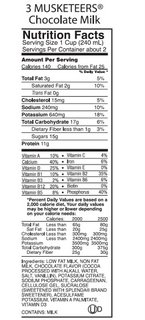
The candy industry is crowing about the 3 Musketeers Slammers milk beverage from Bravo! Foods, which appears to meet the standards of the agreement for use in all schools, even vending machines in elementary schools.

Note also the Real seal, from the federal government's dairy checkoff program (the one that still seems to be withholding its annual report to Congress).

How can this sewn-together Frankensteinian multi-brand candy marketing vehicle possibly meet the new standards for elementary school children, you may ask? A look at the Nutrition Facts label reveals the answer: lowfat milk, carrageenan, cellulose gel, and Splenda artificial sweetener. With these ingredients, the calories per 8 oz. serving fall just under the required 150 [Note 10/08/2006: I missed that the package contains 2 servings! Correction in the comment section].

Problems include: using artificial fillers to mimic that mouth feel of fats rather than letting children become accustomed to the natural lowfat product, using artificial sweeteners rather than letting children become accustomed to the naturally perfect barely-sweet product, and misusing schools to market candy to elementary-age children.

I suspect the Clinton Foundation's reputation with sensible moderate pro-nutrition parents will be ruined if products like this are the ultimate fruit of the agreement with the American Beverage Association. If container-side advertising for 3 Musketeers is permitted under the Clinton agreement, it will push school districts that care about their children toward stricter standards. For example, a nice simple set of rules would be based on a short list of permitted products: water and 8 oz. containers of lowfat unsweetened milk or perhaps 100% fruit juice.

[Hat tip to the sharp and engaging weblog Weighty Matters, which I only recently started reading and will now add to my RSS subscriptions.]
Friday, October 06, 2006

Touring New England -- "Three voices: what fair trade means to farmers"

If you live in New England and would be interested to hear about fair trade principles from farmers around the world, see the Red Tomato news page:
Three Voices: What Fair Trade Means to Farmers
New England Speakers Tour Oct 23-28, 2006

Monday, Oct 23 Burlington, VT

Tuesday, Oct 24 Tufts University, Medford, MA
Fair Trade Banana Banquet, Haley House, Roxbury, MA

Wednesday, Oct 25 Smith College, Amherst, MA

Thursday, Oct 26 Harvard University, Boston, MA

Friday, Oct 27 Putney, VT

A banana farmer from Ecuador, a watermelon and vegetable farmer from Georgia, and an apple grower from New England may seem worlds apart, but they share common challenges as small farmers trying to make it in a global food system.

Join us for this rare opportunity to hear three real-life farmers from three very different farms talk about their struggles to stay on the land, their experiences in the market, and the impact of consumer support for fair trade and family farms. The program will tour New England Oct. 22-28, 2006, and is presented by Oke USA and Red Tomato, with support from Equal Exchange.

Celebrate this ‘fair trade fruit salad’ with fresh fruit tastings, fair trade chocolate fondue, tossed together with the provocative and inspiring stories of three farmers.
The program is presented by Oke USA and Red Tomato, with support from Equal Exchange. See also the Federation of Southern Cooperatives Land Assistance Fund.

Thursday, October 05, 2006

The danger of straying from the topic

Nicholas at the beer and food weblog Pint and Fork offers a lively commentary about off-topic digressions by otherwise-appealing food policy advocates.
People have asked me why I haven't supported groups like the Organic Consumers' Association or the Family Farm Defenders. These groups have admirable goals but their voice is deleteriously affected by "off topic" opinions.

Before I dish, let me say that I have the greatest respect for these groups when they are "on topic."... It would seem odd, then, that these groups would go out on a limb to do things that are politically controversial, completely unrelated to their mission statements, and divisive.
For example, Pint and Fork objected to a link on the Organic Consumers' Association website to an article about what Karl Rove may be planning in terms of an "October Surprise." I can see the point. It might be wiser for the Organic Consumers' Association to pitch itself as progressive but non-partisan.

As another example, Nicholas criticized Family Farm Defenders for linking to the pacifist farmers' group Farms Not Arms. Here, however, I found the alliance more reasonable and on-topic. Both are small progressive farmers' advocacy groups, and pacifism is not really a partisan position. Nicholas wrote, "I consider pacifism a radical political idea, and one that is extraordinarily divisive." But that's quite an ironic accusation. Pacifism may be divisive, but the warriors of the world aren't exactly sitting around together holding hands and singing Kumbayah.

In a class on U.S. Food Policy, I teach the advocacy coalition framework, which deals with the sometimes strange and temporary alliances between very different groups that find themselves on the same side of a particular policy debate. Think of ACLU and Nazis, for example. The danger with these coalitions is that liaison with a sometimes hated enemy can alienate core loyal constituencies. The Pint and Fork commentary provides a good example of this type of hazard.

Comments are open for your thoughts about which of Pint and Fork's criticisms you agree with. Feel free, while we're at it, to voice any objections to my own occasional off-topic commentaries. I am happy to listen and even change my ways.

Sukkot agricultural festival

The joyous celebration of Sukkot begins tomorrow at sundown.

Rabbi Scheinerman explains the meaning of this seasonal harvest festival:
Sukkot marks the autumn harvest time. It is a festival devoted to thanksgiving for the abundance of life. In ancient times, the final agricultural harvest took place in the beginning of the autumn and following the intensely busy work of harvesting people would celebrate their abundance and give thanks to God. In time, the festival of Sukkot came to be associated with the Forty Years of Wandering in the Wilderness, as well. Since crops must be harvested quickly, once they ripen, farmers often built for themselves small temporary booths out in their fields so that they could take advantage of every minutes of daylight once the crops were ready to be picked. These temporary booths were associated with the temporary shelters built by our ancestors after they left Egypt when, for 40 years, they wander through the wilderness of Sinai, before entering the Land of Israel.

Sunday, October 01, 2006

Dependent upon our local place...

Wendell Berry says:
"Put the interest of the community first. Love your neighbors--not the neighbors you pick out, but the ones you have. Love this miraculous world that we did not make, that is a gift to us. As far as you are able make your lives dependent upon our local place, neighborhood, and household--which thrive by care and generosity--and independent of the industrial economy, which thrives by damage."
I heard this passage quoted today from the pulpit of the church that my family happily found three years ago this Fall, not by "shopping" for the place of worship that best satisfied our desires or reinforced what we already thought, but rather by visiting our local church -- the church whose corner we passed every day.

The passage made me reflect on my weekend bike ride the previous day, in the captivating early New England autumn. With camera in pocket, too (click for better images). This ride always exercises my mind as well as my body. Here, in a distance from our urban home that can be covered without gasoline power, one finds all the elements of Berry's proposal.

Here are the generous souls of the Food Project -- who work to connect urban youth with good food and agriculture -- harvesting sweet potatoes.


Here is the bustling farmers' market in Concord...


... with the table of volunteers who are trying to preserve Thoreau's Farm, the writer's birthplace. Isn't that appropriate to the day's theme?


Back home on the Minuteman Bikeway, a delightful world-class urban rail-to-trail that passes near our street (alas, Blogger is not letting me add any more photos!).